
Swollen Turbinates & a Persistently Blocked Nose
A nose that feels constantly stuffy can be frustrating—especially when there is little discharge to clear. You may struggle to breathe comfortably through one or both sides, rely on mouth breathing, or find that the blockage changes during the day.
One possible contributor is enlargement of the turbinates: curved bony structures inside your nose, covered by a lining rich in blood vessels. They help warm, humidify and filter the air you breathe. When their lining swells, the breathing passage becomes narrower.
The space around these structures also matters. Nasal breathing can be affected by the septum, nasal valves and surrounding anatomy, as well as the condition of the lining. Understanding that combination helps guide an approach suited to your symptoms.
At Cranial Solutions, we assess the cranial and facial framework alongside your breathing, nasal comfort and previous treatments. NasalRx is an option you can discuss following assessment, either on its own or alongside treatment for allergy or inflammation. Our aim is lasting, comfortable nasal breathing.
What do nasal turbinates do?
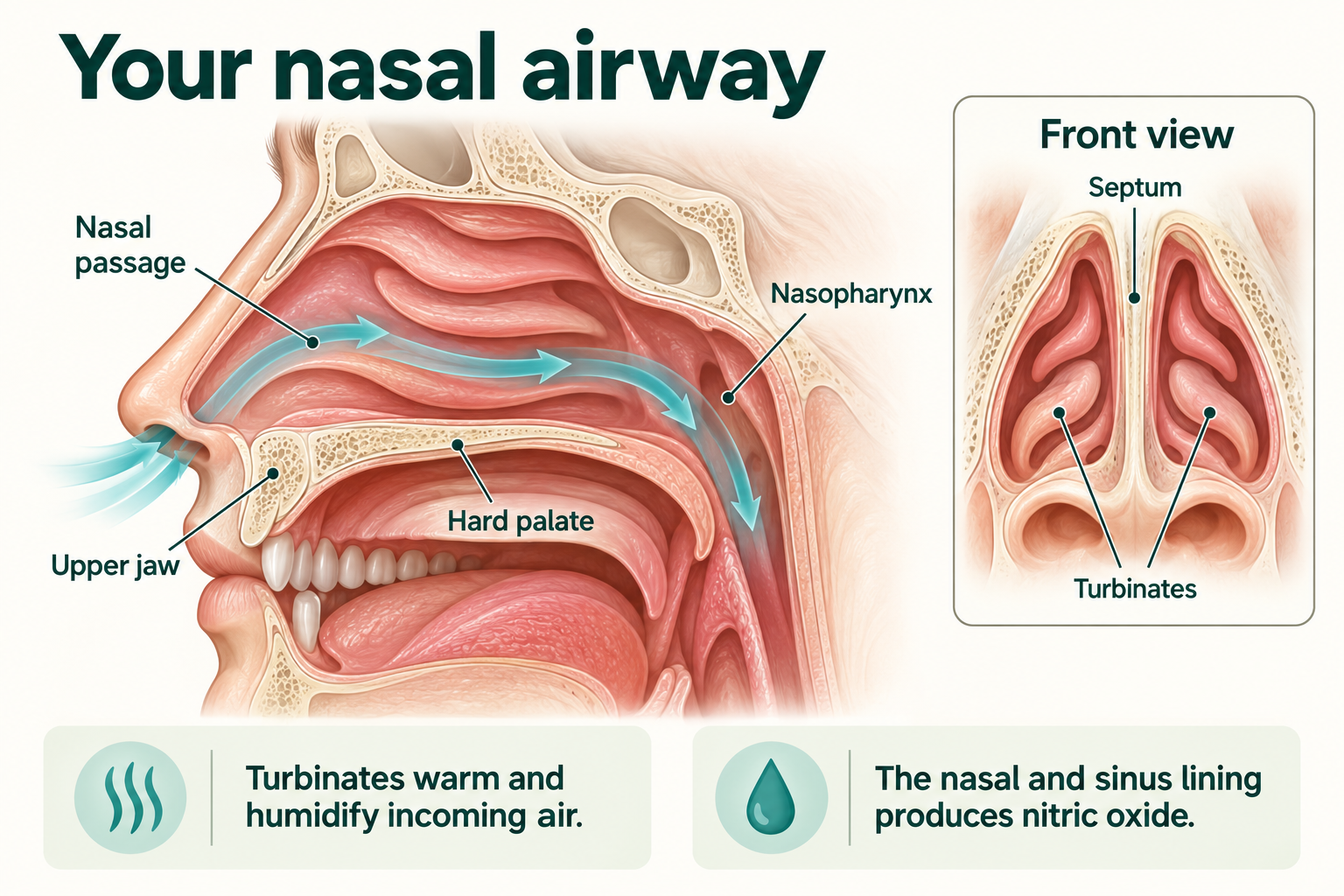
Turbinates are part of your nose’s natural air-conditioning system. Their curved shape and moist lining provide a surface where incoming air can be warmed, humidified and filtered before reaching your lungs.
Most people have three turbinates on each side: inferior, middle and superior. The spaces beneath them are called the nasal meatuses. Comfortable breathing depends on both the space available for airflow and the health of the lining.
Why does the blockage sometimes switch sides?
The blood-rich lining naturally changes in volume. During the normal nasal cycle, airflow tends to shift between the two sides as one side becomes more congested and the other less congested.
This can happen without causing troublesome symptoms. When passages are already narrow or the lining is inflamed, the change may become more noticeable as a blocked feeling that alternates sides. Lying down can also increase congestion.
The aim of treatment is comfortable breathing while preserving the turbinates’ useful role in warming and humidifying air.
Why does my nose feel blocked when there is little to clear?
A blocked nose is not always caused by a build-up of secretions. The lining itself can swell, leaving less room for air to pass. That is why blowing your nose may make little difference.
Allergies, a cold or sensitivity to irritants can contribute to this swelling. Prolonged use of decongestant sprays can also create rebound congestion. Persistent turbinate enlargement may involve the soft-tissue lining, the underlying bone, or both.
The surrounding breathing passage matters too. A deviated septum or narrowing at the nasal valve can restrict airflow alongside an enlarged turbinate. These factors can occur together, so the assessment should consider the whole passage.
At Cranial Solutions, we ask whether the restriction is constant or changes sides, how it affects sleep and mouth breathing, and what previous treatments have changed. This helps us assess whether NasalRx is suitable and whether the nasal lining also needs attention.
The septum and turbinates: how they relate to breathing space
When the septum deviates towards one side, it leaves a narrower passage on that side and a wider passage on the other. An enlarged inferior turbinate is often found in the wider, opposite passage. This pattern is commonly called compensatory turbinate enlargement.
The enlargement can involve the lining, the underlying bone, or both. Its effect on breathing depends on how much usable space remains between the turbinate, septum and surrounding structures.
In a small study of 36 patients, 34 patients (94%) reported improved nasal breathing after septoplasty without turbinate surgery. Follow-up scans at 4–6 months also showed a reduction in the thickness of the enlarged turbinate lining, with no significant change in the bony component. These findings show that breathing can improve without removing turbinate tissue.
At Cranial Solutions, we assess these relationships together. In our clinical experience, NasalRx can improve breathing comfort without removing turbinate tissue. Easier breathing does not necessarily mean the turbinate has reduced in size.
How Cranial Solutions assesses your nasal breathing
We begin with how your nose feels in everyday life: whether one side is consistently harder to breathe through, whether the restriction changes sides, and how it affects sleep, exercise and mouth breathing.
We also review what nasal sprays, allergy treatment or previous surgery have achieved. If you have been told that your turbinates are enlarged, we consider that finding alongside the wider breathing picture.
Our assessment includes palpation of the cranial and facial framework, including the septum, upper jaw and palatine regions. We compare tenderness and the movement we feel through these areas with your description of breathing comfort, before and after treatment.
Where NasalRx is suitable, we generally use a series of six treatments and review your progress throughout. Our aim is lasting, comfortable nasal breathing through an approach that does not remove turbinate tissue. NasalRx can be considered on its own or alongside other care, depending on your assessment.
We track practical changes: easier breathing through each side, less need to mouth-breathe and greater comfort during sleep and daily activities. These help us assess the benefit you experience from treatment.
Treatment options: improving airflow while preserving nasal function
Comfortable nasal breathing depends on an open passage and a healthy, functioning lining. Treatment should consider both.
Addressing swelling and inflammation
When allergy or inflammation contributes to the blockage, suitable treatment may include allergy management, saline or prescribed nasal medicines. Decongestant sprays are intended for short-term use; prolonged use can cause rebound congestion. Steroid nasal sprays work differently and may be appropriate for ongoing inflammatory conditions.
Considering NasalRx before surgery
If restriction persists, the septum, nasal valves and space around the turbinates deserve assessment. At Cranial Solutions, NasalRx offers an approach that does not remove turbinate tissue.
If you are considering elective surgery for persistent nasal blockage, we recommend considering a series of six NasalRx treatments first, where our assessment indicates that this is suitable. This gives us an opportunity to assess how much your breathing comfort and everyday nasal function can improve before proceeding with surgery that removes or permanently alters tissue.
We review your response throughout the protocol. Substantial improvement may mean surgery is no longer needed for your breathing symptoms. If restriction remains, your response can help guide a further discussion with your ENT provider about whether surgery would still offer a worthwhile benefit.
What about turbinate reduction surgery?
An ENT provider may recommend turbinate reduction when persistent enlargement contributes to obstruction despite appropriate treatment. The method and amount of reduction matter.
The turbinates provide a moist surface for warming and humidifying air. Removing substantial tissue can reduce that surface and alter how air travels through the nose, potentially impairing these functions. Approaches that preserve the lining aim to improve airflow while retaining its useful role; some studies have found improved humidification after this type of surgery.
If you are considering surgery, it is worth discussing which structures are contributing to your restriction, what each option aims to change and how the nasal lining will be preserved.
Swollen turbinates: common questions
Does turbinate hypertrophy mean permanent swelling?
No. Turbinate hypertrophy means enlargement. It can involve swelling of the lining, enlargement of the underlying bone, or both. The lining naturally changes in volume and may respond to treatment for allergy or inflammation. Assessment helps distinguish these components.
Why does one side of my nose become blocked when I lie down?
Lying down can increase congestion in the blood-rich turbinate lining. The normal nasal cycle also shifts airflow between sides. If one passage is already narrower, these changes may make that side feel particularly blocked.
Can breathing improve without turbinate reduction surgery?
Yes. The septum, nasal valves and surrounding breathing space also matter. Research on septoplasty alone has shown improved breathing without operating on the turbinates. At Cranial Solutions, we also observe improvements in breathing comfort after NasalRx, which does not remove turbinate tissue. These are different treatments, and the septoplasty study’s success percentage does not describe NasalRx outcomes.
Does easier breathing after NasalRx mean my turbinates have shrunk?
Easier breathing tells us that your breathing comfort has improved. It does not establish whether the turbinate lining or bone has reduced in size. We assess your response through changes in nasal breathing, mouth breathing, sleep-related comfort and repeat clinical examination.
Can I discuss NasalRx if I have already been offered surgery?
Yes. You can book an assessment at Cranial Solutions to discuss whether a six-treatment NasalRx series is suitable before elective surgery for nasal blockage. We review your response throughout. If restriction remains, you can discuss the remaining symptoms and the potential benefit of surgery with your ENT provider.
Explore related topics
- Blocked nose and sinus pressure — the wider guide to nasal breathing and sinus comfort.
- Deviated septum: symptoms and treatment options — understanding the septum and surrounding breathing space.
- Nasal sprays and rebound congestion — the differences between sprays and their effects with prolonged use.
- Post-nasal drip — discharge, throat clearing and related symptoms.
- NasalRx safety and what to expect — preparing for assessment and treatment.
References and further reading
- ENT Health: Turbinate hypertrophy, anatomy and treatment options.
- AAO-HNS: Nasal valve anatomy and assessment.
- Kim and colleagues (2008): Turbinate mucosal and cross-sectional changes after septoplasty alone; not a NasalRx study.
- Computational study of total turbinate removal, mucosal surface area and air conditioning; findings do not describe all tissue-preserving surgery.
- Khayat and Mazhar (2012): Septoplasty alone in 36 patients; 34 (94%) reported improved nasal obstruction. Follow-up CT showed reduced mucosal thickness without significant bony change. The 94% figure describes reported breathing improvement, not a rate of complete turbinate regression or NasalRx success.
- Lindemann and colleagues (2008): A small clinical study found improved measured intranasal air conditioning after septoplasty, with or without mucosa-preserving turbinoplasty.
These sources support nasal anatomy and conventional assessment. They do not establish NasalRx outcomes or its proposed structural mechanisms.