
Migraine & Headache Behind the Eyes
Pain or pressure behind the eyes can be a particularly disruptive part of migraine and other headaches. It can make reading, working at a screen or enjoying everyday activities uncomfortable, especially when it occurs alongside facial pressure or neck stiffness.
At Cranial Solutions, we explore how these symptoms fit into your wider pattern. The eye muscles, the optic nerve’s protective coverings and the surrounding cranial and facial structures form a closely connected system. Understanding these relationships offers another perspective on discomfort around the eyes.
Our clinical approach considers whether structural contributors may be accompanying your migraine or headache. This page explains the anatomy behind that perspective and how we assess your symptoms, eye tracking, cranial and facial relationships, and upper neck.
The Sphenoid, Optic Canal & Dural Sheath
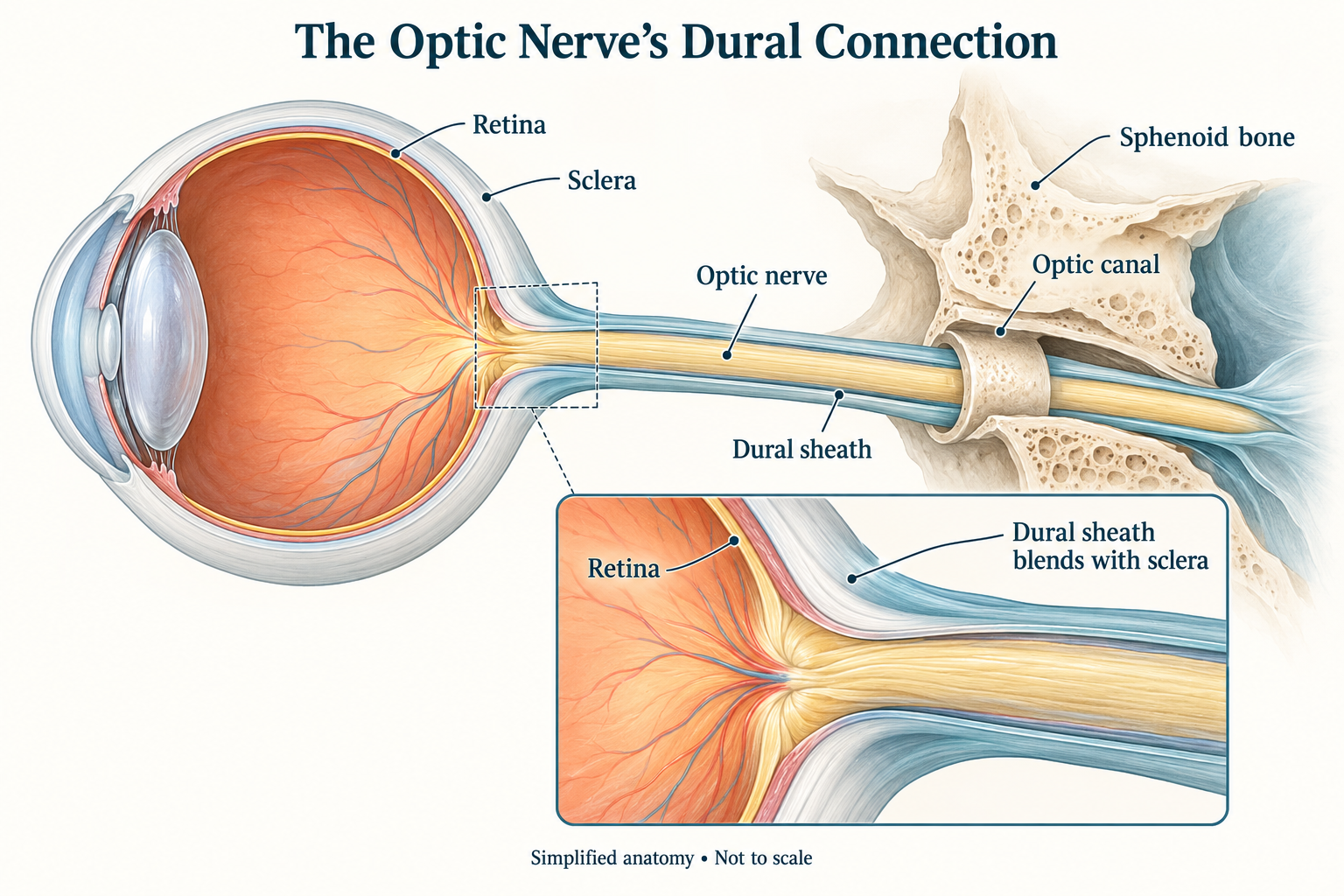
The sphenoid sits near the centre of the skull, behind the eyes. It connects with several cranial and facial bones, including the occiput at the skull base. Within the sphenoid are two small passages called the optic canals—one for each optic nerve.
As the optic nerve passes through this region, its protective sheath has connections with the surrounding tissues and the lining of the bony canal. Further forward, the dural sheath blends with the sclera, the strong outer coat at the back of the eye. Inside the eye, the retina’s nerve fibres come together to form the optic nerve.
The question we explore is whether a mechanical contributor may accompany a person’s migraine and eye discomfort. The presence of a narrow optic canal alone does not mean that the nerve is compressed.
How Might Dural Tension Relate to Eye Discomfort?
For people living with migraine, discomfort around the eyes may accompany head pain, facial pressure or neck stiffness. At Cranial Solutions, we consider how these symptoms fit together within the wider cranial–dural system.
The optic nerve’s dural sheath connects with the tissues at the skull base and the sclera at the back of the eye. Because these tissues are physically connected, they can transmit mechanical forces. Research into eye movement demonstrates that traction through the sheath can place stress on tissues around the optic nerve’s entry into the eye.
Our clinical model explores whether tension within the cranial and facial system could influence loading through these connections and contribute to discomfort around the eyes.
This proposed mechanical relationship concerns accompanying eye discomfort. Typical migraine aura—the spreading zigzags, shimmering patterns or blind spots—is associated with changes in the brain’s visual processing. The two experiences may occur together, but they need not share the same mechanism.
Light Sensitivity & Migraine
When light becomes uncomfortable, everyday activities such as driving in daylight, working under bright lighting or looking at a screen can feel much harder. Light sensitivity can accompany migraine even when there is no visual aura.
Research has identified connections between light signals from the retina and pain pathways that also receive signals from the dura. This helps explain how light can intensify migraine pain. We consider light sensitivity alongside eye discomfort, eye tracking and the wider cranial and neck assessment, and review changes in your ability to manage light and screens as treatment progresses.
The Eye Muscles & Their Structural Support
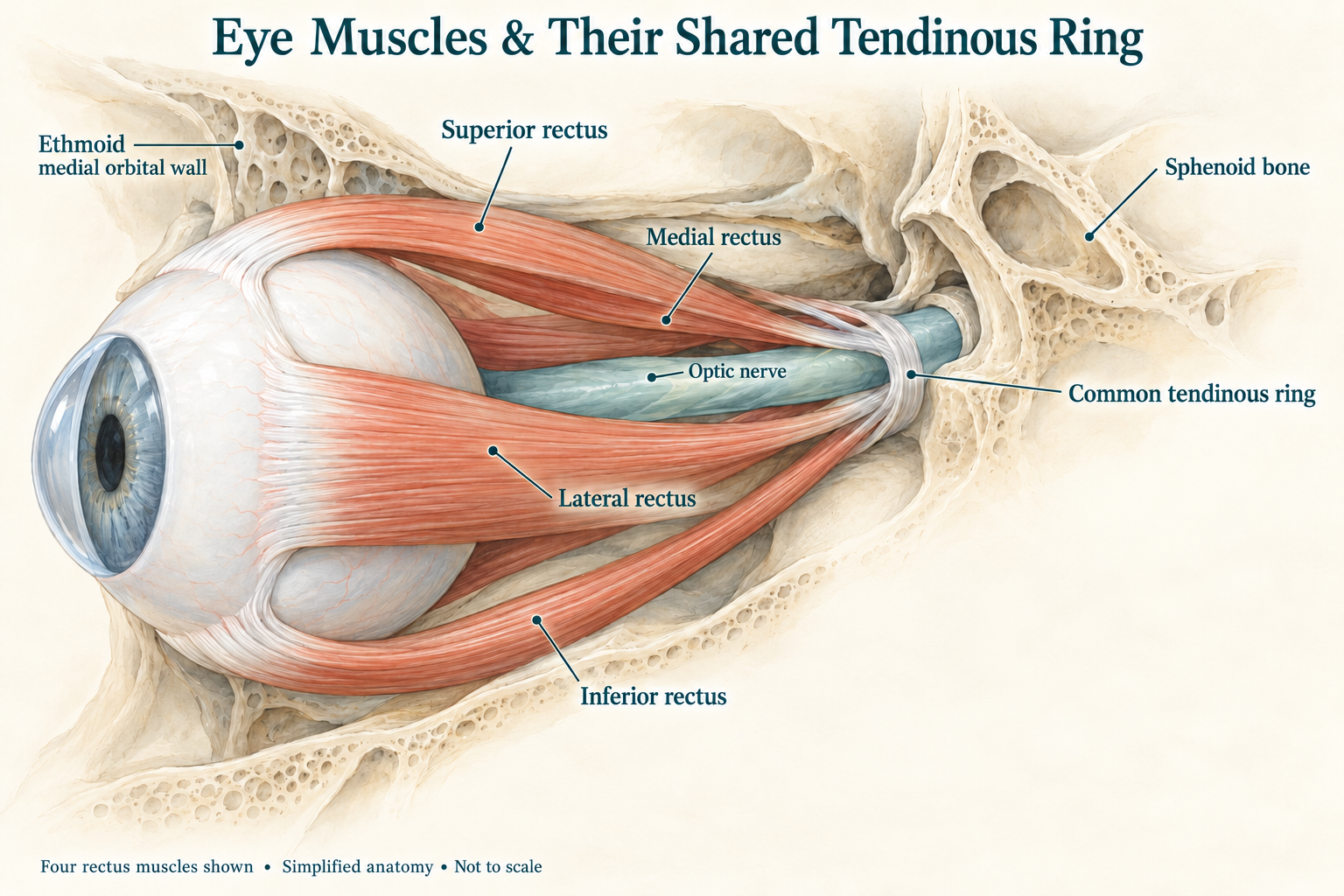
The muscles that move your eyes work within a closely connected system of bones, tendons and supporting tissues. Four of these muscles arise from a shared tendinous ring deep within the eye socket, beside the optic canal. This ring has connections with the sphenoid and the optic nerve’s protective sheath.
As these muscles travel towards the eye, connective tissue sleeves help guide their movement and link them with the surrounding orbital tissues. The ethmoid forms much of the inner wall of the eye socket, contributing to this wider structural setting.
Discomfort can arise from the eye muscles’ tendons and supporting structures, as well as from migraine itself. This makes the relationship between muscular activity and structural support relevant when considering pain around the eyes.
How We Assess the Wider Pattern
When migraine occurs alongside discomfort around the eyes, we look at how your symptoms fit together. Do they develop with neck stiffness or facial pressure? Are they associated with reading, screen use or eye movement? Do visual changes occur before the pain, during an attack or independently?
Your medical and eye-care history informs a hands-on assessment of the cranial, facial and upper cervical relationships.
We also examine eye tracking—how your eyes follow a moving target—and note any associated discomfort or difficulty.
Our assessment includes palpation of the cranial and facial bones before and after treatment, together with neck movement and your feedback. These hands-on findings help guide our care; we interpret them alongside how you feel and function.
Where appropriate, NasalRx forms part of an individual treatment approach that considers the cranial and facial system together with the upper neck. In our clinical model, the aim is to address structural contributors that may be accompanying your migraine and eye discomfort.
We follow changes that matter to you: the frequency and intensity of migraine attacks, discomfort around the eyes, tolerance of everyday activities and your ability to return to things you enjoy. If you experience aura, we also record its frequency, duration and character, rather than assuming that improvement in head pain means the visual symptoms have changed.
When Visual Symptoms Need Medical Assessment
Understanding your usual migraine pattern is helpful. If visual symptoms occur for the first time, change significantly or last longer than usual, seek prompt medical assessment—even if you already experience migraine.
Sudden loss of vision, a dark curtain across your sight or vision loss affecting only one eye needs urgent assessment. These symptoms should not be assumed to arise from migraine or structural tension.
Call 111 and ask for an ambulance if sudden visual changes occur with new weakness, facial drooping, difficulty speaking or a sudden, exceptionally severe headache.
Once your symptoms have been assessed, we can consider how our approach fits alongside your medical and eye care.
Frequently Asked Questions
Why might migraine cause pain behind the eyes?
Pain behind the eyes can occur as part of migraine, but the location alone does not identify its cause. The eye muscles, surrounding tissues and optic nerve coverings also have important structural relationships.
At Cranial Solutions, we consider your migraine pattern alongside these relationships, rather than assuming that all discomfort behind the eyes has the same explanation.
Can a headache cause pain behind just one eye?
Yes, migraine and some other headache conditions can produce pain around or behind one eye. We consider whether it is part of your familiar headache pattern or a new or different symptom. New or unusual eye pain needs medical or eye-care assessment, particularly when accompanied by visual changes.
Is pain behind the eyes the same as migraine aura?
No. Pain or pressure around the eyes and migraine aura describe different experiences. Aura can include temporary shimmering patterns, spreading zigzag lines or blind spots, and can occur with or without a headache. Eye discomfort and aura may occur together, but one does not establish the cause of the other.
Could eye-muscle or dural tension contribute to discomfort around my eyes?
The eye muscles, their supporting tissues and the optic nerve’s dural sheath have physical connections with the eye socket and skull base. Research demonstrates that these structures can transmit mechanical forces.
At Cranial Solutions, our clinical model considers whether structural relationships could contribute to accompanying eye discomfort. We explore this through your symptom history, eye-tracking examination, cranial and facial palpation, and upper-neck assessment. These findings help guide care; they do not establish the cause of migraine aura.
How does NasalRx fit into care for migraine with visual symptoms?
Where appropriate, NasalRx forms part of our individual approach to the cranial, facial and upper-neck relationships. We consider your visual symptoms alongside migraine attacks, eye discomfort and the effect these have on daily life.
We review your response through your feedback, examination findings and changes over time. When aura is present, we track it separately from head pain and eye discomfort so that we understand which aspects of your condition are improving.
Explore Your Options for Migraine Care
If migraine and discomfort around your eyes are interrupting your life, we welcome the opportunity to understand your experience and discuss whether our approach could be suitable for you.
Our aim is to help you achieve substantial improvements in symptoms and return to the activities you enjoy. An individual assessment is the starting point for planning your care.
Enquire about an assessmentResearch & Further Reading
These sources explain the anatomy, ocular biomechanics and visual symptoms discussed on this page. The proposed relationship between cranial structural patterns and accompanying eye discomfort reflects our clinical model; the cited studies do not establish NasalRx as a treatment for migraine aura.
- Optic nerve connective tissues: human anatomical study (2022)
- Formation and fixation of the common tendinous ring: anatomical study (2022)
- Structure-function correlations in human medial rectus muscle pulleys (1996)
- Posterior scleral deformation during optic nerve traction: postmortem experiment and modelling (2024)
- Mechanisms of migraine aura: human functional MRI study (2001)
- Clinical features and long-term prognosis of trochlear headaches (2014)
- International Headache Society: migraine with aura
- Vision loss: when to seek medical help
- 111 emergency service
- Noseda et al. (2010): A neural mechanism for exacerbation of headache by light