
Neck Pain, Migraine & Headaches: How Are They Connected?
If you live with migraine, neck stiffness and tenderness at the base of the skull may feel like part of the same problem. Your neck may tighten before an attack, remain sore afterwards, or limit how comfortably you turn your head.
The head and upper neck are closely connected through shared sensory pathways and the relationships between muscles, connective tissues and the protective dura. Understanding these connections helps us look beyond an isolated sore muscle and consider your symptoms together.
At Cranial Solutions, we assess the cranial base, facial structures and upper neck as a connected system. NasalRx and cervical care form part of this approach, guided by hands-on findings and the changes you experience following treatment.
Why Migraine and Neck Pain Often Occur Together
Neck pain is common among people living with migraine. It may appear before an attack, increase while symptoms are at their worst, or linger after the head pain has settled.
For some people, neck discomfort follows their migraine pattern closely. Others also experience ongoing stiffness, tenderness or restricted movement between attacks. Understanding your pattern helps us decide what to assess and how to approach care.
Shared Pain Pathways
Sensory signals from the head and upper neck meet within connected pathways in the brainstem and upper spinal cord, known as the trigeminocervical complex. This overlap helps explain why pain in these regions can be experienced together, and why symptoms may spread between the head and neck.
These pathways are one part of the picture. At Cranial Solutions, we also consider the connected anatomy of the cranial and facial bones, including their relationships with the sphenoid—a central bone at the skull base—and its connection with the occiput at the back and base of the skull.
We assess these relationships alongside the jaw, upper cervical joints, deep neck muscles and protective dura. Your symptoms, movement and hands-on cranial, facial and cervical findings guide how we bring NasalRx and cervical care together in your treatment.
Is Your Neck Pain Part of Migraine—or a Headache Coming from the Neck?
Neck pain and head pain can occur together in different ways. Understanding your pattern helps us make sense of your symptoms and plan your care.
Neck Pain Accompanying Migraine
Neck stiffness or tenderness may be part of the migraine experience, appearing before, during or after an attack. Some people also have a coexisting neck problem, with discomfort or restricted movement between attacks.
We consider when your neck symptoms occur, how they relate to your migraine attacks, and what we find during examination.
Cervicogenic Headache
A headache arising from a disorder of the neck is called cervicogenic headache. Pain may spread from the upper neck or base of the skull towards the forehead or eye. Neck movement or pressure over particular structures may reproduce the familiar head pain.
These features can overlap with migraine, so they need to be interpreted alongside your history and examination.
Looking at Your Whole Presentation
You may experience migraine alongside a cervical problem. At Cranial Solutions, we assess the cranial and facial relationships, jaw and upper neck together, considering how the findings relate to your symptoms.
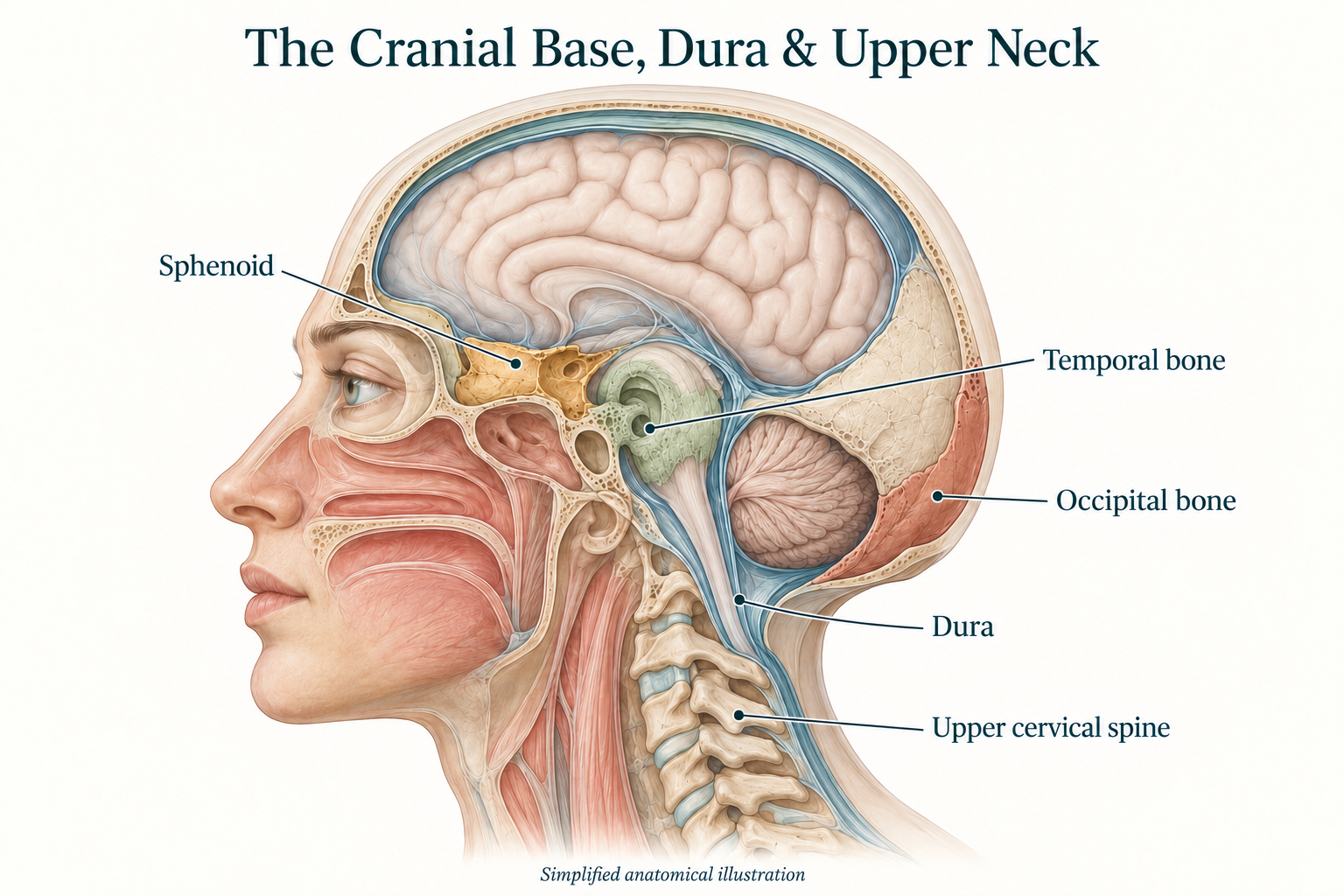
The Cranial Base, Dura & Upper Neck
The upper neck meets the skull at the occiput. Further forward, the sphenoid occupies a central position at the cranial base, with connections to several cranial and facial bones and to the occiput.
The dura has important attachments within this region. Its supportive folds relate to the sphenoid, temporal and occipital bones, making these relationships relevant to our interest in the head and neck as a connected system.
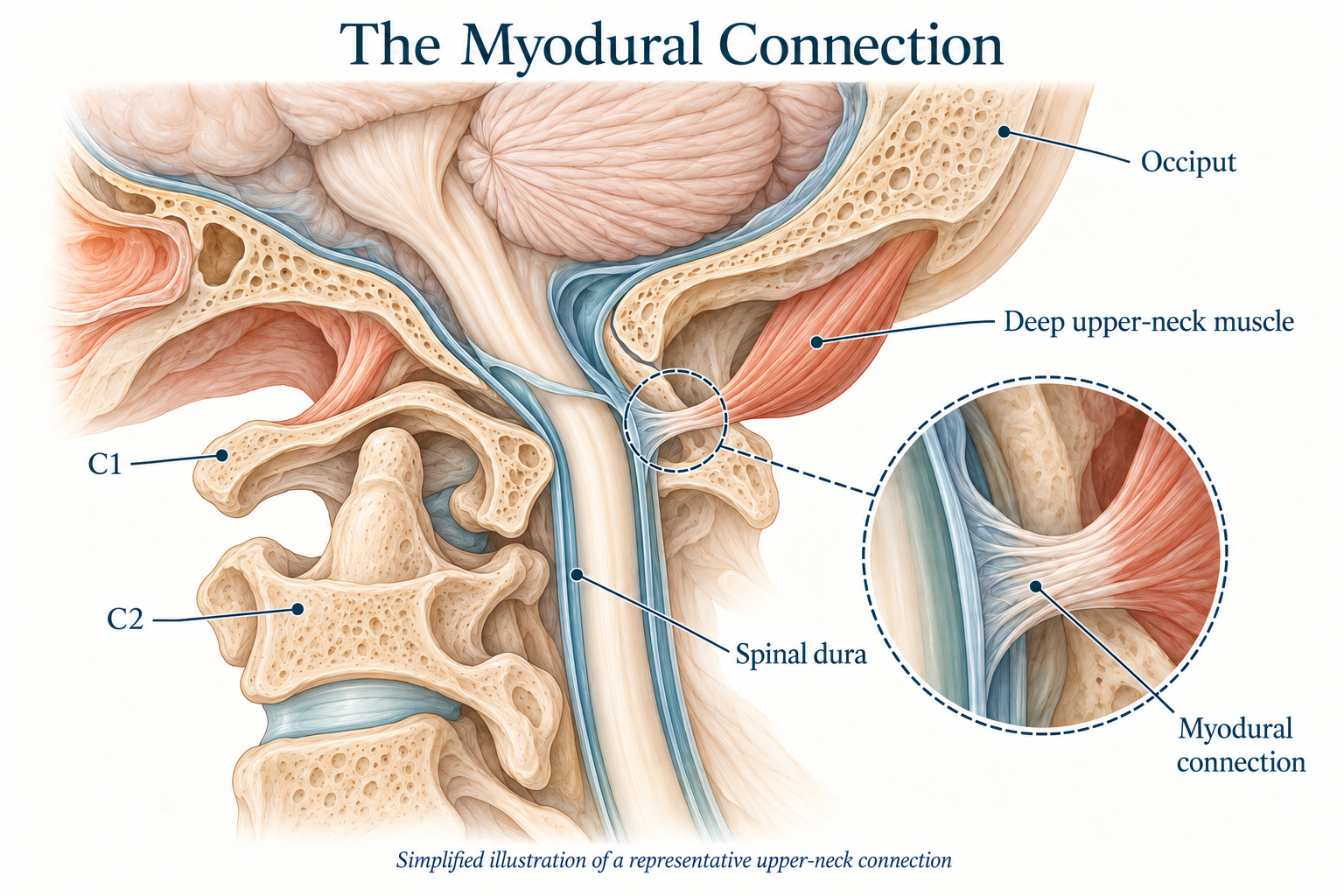
The Myodural Bridge
Several small muscles beneath the back of the skull have connective-tissue links to the spinal portion of the dura—the tough, protective membrane surrounding both the brain and spinal cord. These attachments form part of the myodural bridge complex.
They provide a physical connection through which muscular loading can be transmitted to the dura. Researchers are also investigating how these relationships may influence cerebrospinal fluid movement.
There may be a two-way interaction: muscular loading can influence dural mechanics, while pain-related sensory feedback may influence neck muscle activity. We consider this possible interaction alongside the wider cranial and facial relationships.
Why These Connections Matter in Our Assessment
Our assessment brings together the cranial and facial bones, sphenoid and occipital regions, jaw and upper cervical function. We compare hands-on findings with your symptoms and movement, then reassess after treatment.
Our Connected NasalRx & Cervical Approach
At Cranial Solutions, we bring cranial, facial and cervical assessment together in one treatment approach. NasalRx is central to this care, with cervical treatment included where appropriate to your findings and symptoms.
We consider the relationships between the facial and cranial bones, sphenoid and occiput, jaw, upper cervical joints and deep neck muscles. Our clinical rationale focuses on how these structures relate to mobility, mechanical loading and the protective dura.
Comparing Before and After Treatment
Before treatment, we assess cranial and facial structures through hands-on palpation, alongside neck movement, tenderness and your symptom pattern. We repeat relevant assessments afterwards to compare what has changed.
Drawing on many years of daily clinical experience, we often find that changes felt during palpation closely correspond with the improvements patients describe. These hands-on findings are interpreted alongside your feedback and movement, helping guide the next steps in care.
Changes That Matter in Everyday Life
We review the frequency and intensity of migraine attacks and other headaches, together with neck stiffness, head pressure, eye discomfort and light sensitivity. We also ask what those changes mean for your work, sleep and ability to enjoy daily activities.
In our clinical experience, improvements following NasalRx can be profound. Our goal is a substantial reduction in the burden of migraine and associated symptoms, helping you return to the activities that matter to you.
Frequently Asked Questions
Why does my neck become stiff before a migraine attack?
In our clinical model, neck stiffness before a migraine attack can reflect developing tension within the cranial–dural system. The myodural bridge links deep upper-neck muscles with the spinal dura, creating a physical relationship between these tissues. We therefore assess the wider cranial and facial relationships—including the sphenoid and occiput—alongside the upper neck when exploring this pattern.
Can a neck problem cause headaches as well as accompany migraine?
Yes. A disorder of the neck can cause cervicogenic headache, and a cervical problem can also coexist with migraine. Your symptom history, movement and examination help us understand the pattern. A stiff or tender neck alone does not establish which type of headache you have.
Why do my neck symptoms return after massage or stretching?
In our clinical model, recurring muscular tension may be a secondary response to an underlying bony or structural restriction. Massage or stretching can ease the muscle discomfort, while symptoms may return if a contributing structural pattern persists. Our approach assesses the cranial, facial and upper cervical relationships together, aiming to address relevant structural contributors as well as the muscular response.
How does NasalRx fit into care for migraine and neck symptoms?
Our clinical rationale centres on the relationships between cranial and facial mobility, the cranial base and the protective dura. NasalRx is central to this approach, with cervical care included where appropriate. We compare hands-on findings before and after treatment alongside changes in your migraine attacks, neck movement and associated symptoms. Our Migraine & Headache page explains this approach in more detail.
Research & Further Reading
These sources explore migraine-associated neck pain, cervical headache and the myodural connections between upper-neck muscles and the dura. They provide background to the anatomy and headache patterns discussed here. Our NasalRx observations reflect clinical experience and patient feedback.
If migraine and recurring neck symptoms are affecting your daily life, an assessment can help you explore whether our connected cranial and cervical approach is appropriate for you.
Book a Migraine & Headache Assessment