
Snoring: Causes, Nasal Breathing & Treatment Options
Snoring can disturb your sleep, your partner’s sleep and the way you feel the next morning. If it keeps returning, understanding what contributes to it is a useful starting point.
At Cranial Solutions, we explore nasal breathing and the connected cranial and facial framework to understand what may be contributing to your snoring.
What causes snoring?
Snoring is the sound of tissues vibrating as air passes through the upper airway during sleep. The soft palate, uvula, tongue and surrounding throat tissues can be involved. The useful question is what makes those tissues more likely to vibrate in your case.
Nasal airflow and the breathing route
When nasal breathing is restricted, you may rely more on mouth breathing during sleep. This changes the relationship between airflow, jaw position, the tongue and soft palate, and can contribute to snoring. Nasal restriction may involve the septum, turbinates, nasal lining or surrounding facial framework.
Why snoring varies between nights
Sleeping position, alcohol, temporary congestion and other changes can affect snoring. This variation is why a pattern recorded over several nights is more useful than a single night.
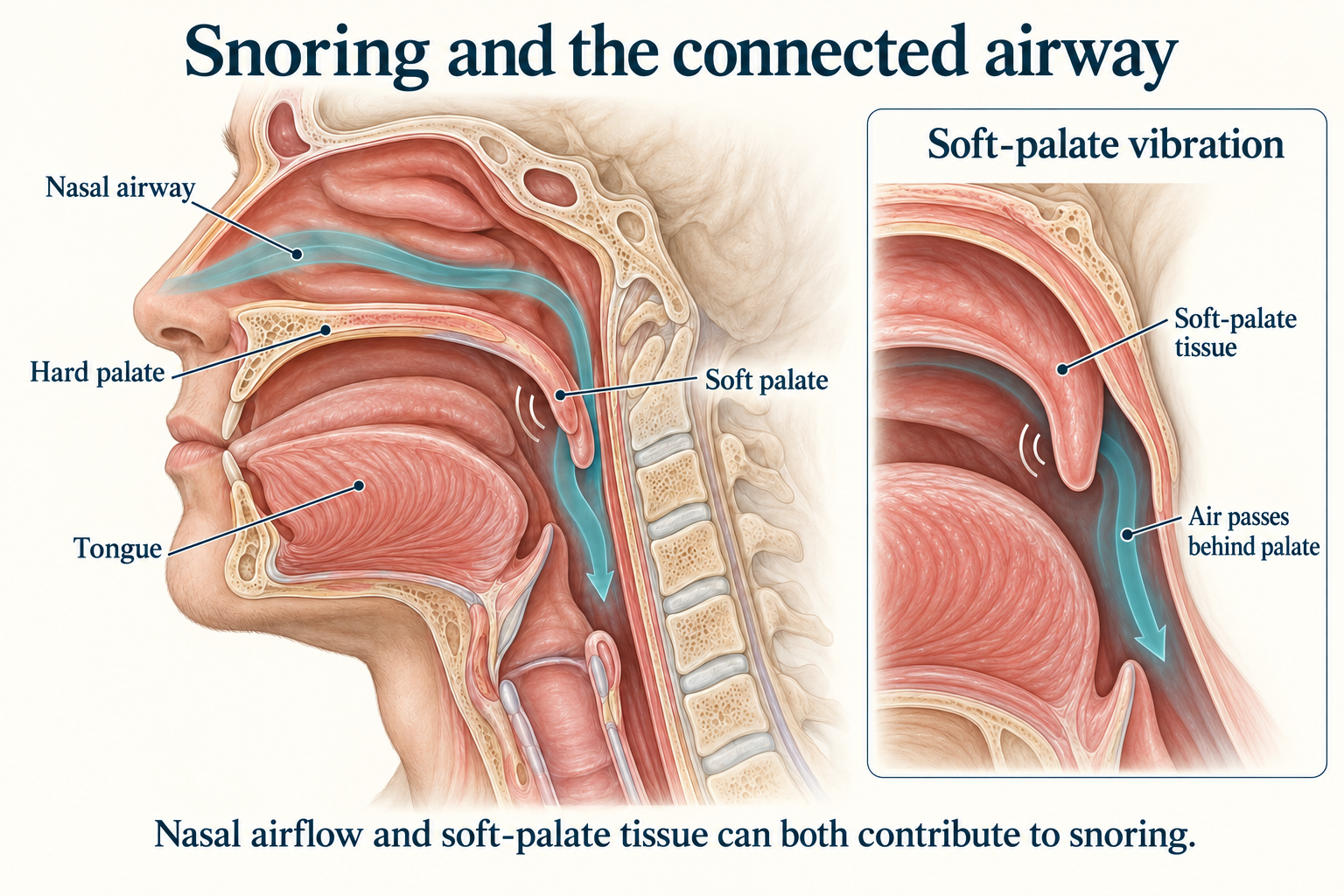
Nasal airflow and soft-palate tissue are different contributors
The maxilla and palatine bones form the hard palate and help shape the space within the nose and mouth. Behind it, the flexible soft palate can vibrate as air passes through during sleep. Its laxity, thickness and tissue condition matter alongside tongue position and the available throat space.
Opening nasal airflow may reduce an important contributor to snoring. Where excessive soft-palate laxity or other tissue changes remain, improving nasal breathing may need to be complemented by care directed at those tissues. We explain oral laser treatment as one possible option below.
Before your first appointment: record a snoring baseline
We recommend using SnoreLab before your first appointment. The app provides overnight recordings and a Snore Score reflecting snoring intensity and duration.
If possible, record several typical nights and bring your results to the appointment. Follow the app’s setup instructions and keep your phone placement consistent so comparisons are more useful.
How we assess snoring at Cranial Solutions
Your assessment brings together nasal airflow, the connected cranial and facial structures, palate relationships, tongue position and jaw movement. We also consider your sleep history, previous treatment and what your partner notices. Your SnoreLab baseline provides a starting point for reviewing progress.
Following your response to NasalRx
Where NasalRx is suitable, we recommend a series of six treatments. We compare breathing comfort and palpatory findings before and after treatment, then review how those changes carry through to sleep.
In our clinical experience, patients frequently report reduced snoring alongside easier nasal breathing after NasalRx care. Our primary aim is to resolve snoring where possible. When it persists, a substantial reduction in its intensity, duration and disruption is a valuable improvement.
Continue recording during the protocol and afterwards. We review SnoreLab trends alongside easier nasal breathing, less reliance on mouth breathing, sleep comfort and partner feedback. These changes help us follow your response and decide whether a remaining soft-palate contribution needs separate attention.
Snoring and sleep apnoea are different outcomes
Where sleep apnoea has been diagnosed, we also consider the relevant sleep-test findings. SnoreLab helps track snoring; it does not replace a sleep study or establish whether obstructive breathing events have resolved.
Choosing a treatment approach for snoring
The most useful approach depends on what is contributing to your snoring. Nasal restriction, jaw and tongue position, soft-palate behaviour and sleep-related factors may need different forms of care.
Considering NasalRx
At Cranial Solutions, NasalRx offers a non-surgical approach for suitable patients where nasal and cranial–facial relationships are relevant. You can arrange an assessment whether you are exploring treatment for the first time or snoring persists after previous care.
When the soft palate needs additional attention
Improving nasal airflow and addressing the vibrating soft-palate tissues are different treatment targets. Longstanding snoring can coexist with swelling, inflammation or altered tissue support. Research suggests repeated vibration may contribute to tissue changes, although those changes can also be part of why snoring develops.
For suitable patients, non-ablative soft-palate laser treatment—such as an Er:YAG approach—may offer an additional way to reduce snoring. It uses controlled heating intended to tighten and remodel the treated tissue, rather than cutting it away. This is different from surgical laser procedures that remove tissue.
At Cranial Solutions, NasalRx aims to improve nasal airflow and the relevant cranial–facial relationships. If snoring remains and the soft palate appears to need a separate assessment, we can discuss assessment by a dentist or other appropriately qualified provider trained in soft-palate laser treatment. Cranial Solutions does not provide oral laser treatment.
Laser care may complement improved nasal breathing where both contributors are present. Suitability depends on the provider’s airway and tissue assessment; swelling alone does not establish that laser tightening is the right approach. The combined NasalRx-and-laser pathway has not been established in controlled trials.
Other options that may be relevant
Sleeping position and evening alcohol intake may be worth reviewing if your recordings suggest they influence snoring. Treatment for nasal inflammation may also help where that is contributing.
A professionally fitted oral appliance can help selected patients by holding the lower jaw forward during sleep. Other nasal or throat treatments may be considered according to the findings.
Where sleep apnoea is present, its treatment forms part of the overall plan. Continue prescribed care while changes are assessed; decisions about reducing or stopping it should follow review with the prescribing clinician.
Frequently asked questions
Can nasal treatment help if I only snore at night?
Yes, it may. Daytime breathing can feel adequate while nasal restriction becomes more noticeable when lying down. We assess that pattern alongside the other structures involved in snoring.
Can I have an assessment if snoring continued after nasal surgery?
Yes. Bring details of your previous treatment and what changed afterwards. We can assess the restriction that remains and discuss whether NasalRx could be suitable.
How many nights should I record with SnoreLab?
Several typical nights provide a more useful baseline than one night. Bring the recordings you have; you do not need to postpone your appointment to collect a perfect set.
What if my snoring improves but does not disappear?
A sustained reduction in intensity, duration and disruption can still be a substantial improvement. We review what has changed and what remains to guide the next steps.
Do I need a SnoreLab score before booking?
No. The app is a helpful tracking tool, rather than a requirement for care. Your experience and your partner’s observations are also useful.
Take the next step towards quieter nights
If snoring is disrupting your sleep or your partner’s, we welcome the opportunity to understand your pattern and explore what NasalRx care could offer.
Bring your SnoreLab recordings if available, along with details of previous treatment. Together, we can work towards quieter nights and more comfortable breathing.
Contact Cranial Solutions to arrange an assessment.
Related reading
- Blocked Nose & Sinus Pressure
- Nasal Breathing vs Mouth Breathing
- Blocked Nose at Night
- Narrow Palate & Nasal Breathing
- Deviated Septum
- NasalRx Safety & What to Expect
Research and further reading
- Non-ablative Er:YAG snoring treatment compared with sham treatment
- Four-year follow-up after non-ablative Er:YAG treatment
- Longer-term outcomes and recurrence after laser treatment
- Soft-palate inflammation and tissue changes in sleep-disordered breathing
- Vibration-induced inflammation in an animal model
- Oral appliance therapy for snoring and sleep apnoea
- Palatine aponeurosis and soft-palate muscle connections
- SnoreLab recording and tracking features
Anatomical research supports the structural discussion. NasalRx outcomes described here reflect Cranial Solutions clinical observations.