
Narrow Palate & Nasal Breathing: How the Roof of Your Mouth Relates to Airflow
The roof of your mouth and the floor of your nose share the same bony structure. This means the palate and upper jaw deserve attention when nasal breathing feels restricted.
A narrow upper jaw or high-arched palate can be part of a facial framework associated with reduced nasal space. These relationships may coexist with septal deviation or a fuller nasal lining, so the palate is one part of the assessment.
At Cranial Solutions, we consider the maxilla and palatine bones alongside the septum, nasal passages, tongue position and jaw movement. Our focus is how this connected framework relates to your breathing comfort.
Where NasalRx is suitable, our aim is lasting improvement in nasal airflow. We review the changes you experience through treatment, including easier breathing and openness in regions that previously felt restricted.
One structure: the roof of your mouth and the floor of your nose
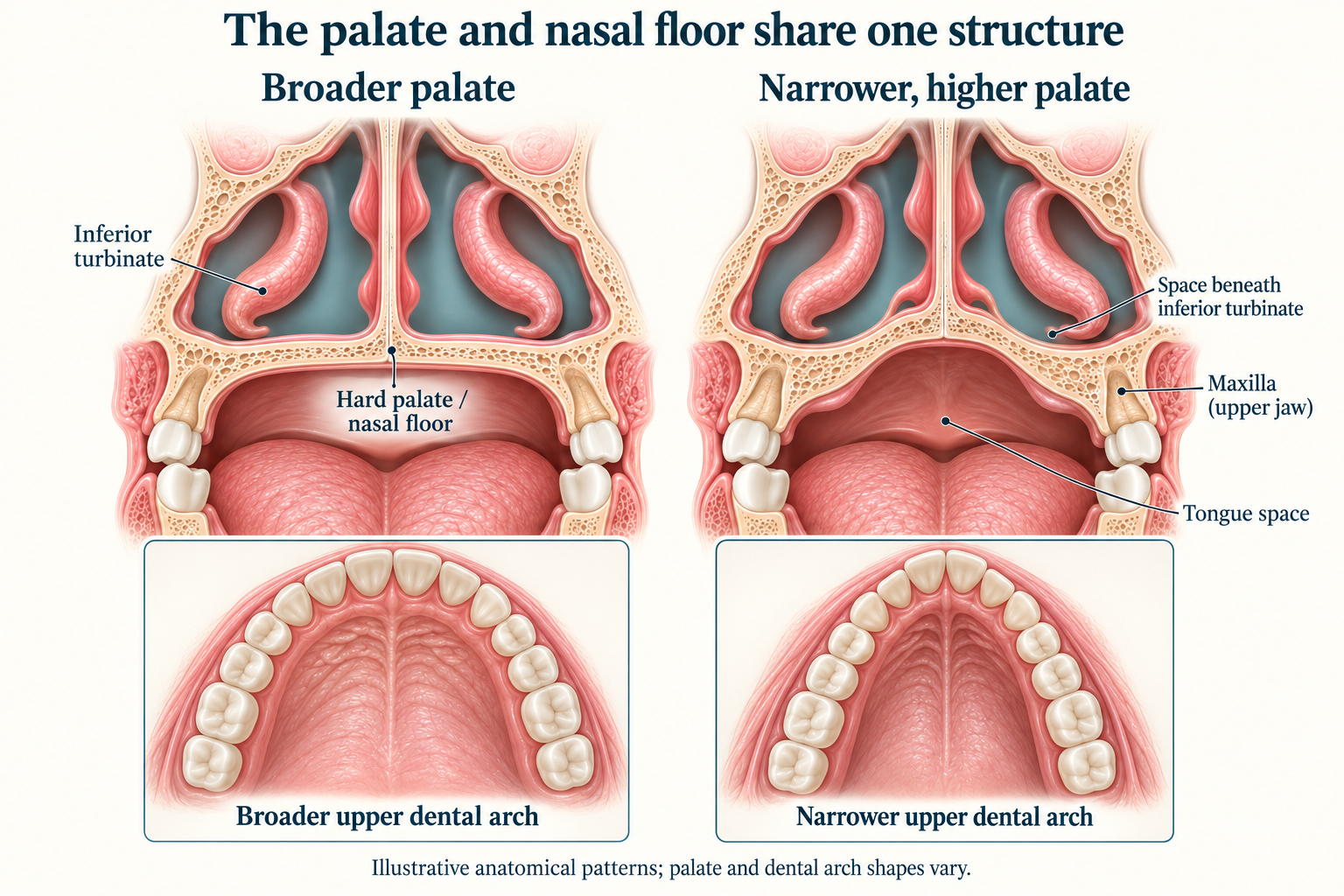
The hard palate is formed by the palatal portions of the maxilla, or upper jaw, towards the front, and the palatine bones towards the back. Its underside forms the roof of your mouth; its upper surface forms the floor of the nasal cavity.
Above this floor, the inferior turbinates curve into each side of the nose. The space beneath them—the inferior meatus—is part of the connected nasal passages through which air moves.
Why palate shape matters
The width and height of the palate are relevant to the surrounding nasal framework. A narrow upper jaw and high-arched palate may accompany a narrower nasal floor, influencing the space available around the lower nasal passages.
However, palate shape alone does not tell us how easily you breathe. The septum, turbinates, nasal lining and other airway regions also contribute. Someone with a high-arched palate may breathe comfortably, while another person experiences restriction involving several of these structures.
At Cranial Solutions, we assess these relationships together, including whether airflow feels restricted on one side, both sides or deeper within the nose.
Childhood habits can influence palate shape
Persistent thumb or finger sucking can influence the developing upper jaw and palate. Studies have found narrower and deeper palatal shapes in children with these habits.
Repeated pressure from the thumb, together with changes in tongue resting position and the balance of forces around the upper arch, may contribute to this development. Inherited anatomy and breathing patterns also play a part.
At Cranial Solutions, a history of thumb sucking or longstanding mouth breathing helps us understand your facial framework. We assess how that framework relates to your current nasal airflow, tongue position and jaw function, rather than assuming that childhood habits explain every restriction.
Palate shape, tongue space and nighttime breathing
The palate is relevant to more than the space inside your nose. The width of the upper arch also helps shape the space available for the tongue to rest comfortably.
A narrow upper jaw may be part of a pattern involving a lower tongue position, mouth breathing or reduced space behind the tongue. These relationships become particularly relevant during sleep, when muscle activity and airway support change.
How this can relate to snoring
Restricted nasal breathing, tongue position and throat space can contribute to snoring. The flexible soft palate’s laxity and tissue condition are separate considerations from the shape of the bony palate.
At Cranial Solutions, we consider nasal airflow, the maxilla and palatine bones, tongue resting position, jaw movement and your sleep history together. During NasalRx care, we review changes in breathing ease and reported snoring alongside our clinical findings.
Our snoring guide explores these contributors and the distinction between snoring and sleep apnoea.
Assessing the palate as part of your nasal airflow
At Cranial Solutions, we examine the palate and upper jaw within the connected facial framework. We consider their shape, symmetry and palpatory findings alongside the septal region, nasal lining, tongue position and jaw movement.
Your experience matters too: whether breathing feels restricted on one side or both, whether airflow changes when lying down, and what previous sprays, surgery or other treatment have achieved.
Reviewing changes through NasalRx care
Where NasalRx is suitable, we recommend a series of six treatments and compare breathing comfort and clinical findings through the protocol.
Patients often describe easier, deeper or more balanced nasal airflow, sometimes noticing openness in areas they had not realised felt restricted. We also review whether those improvements carry through to daily activity and sleep.
Our aim is lasting improvement in nasal function. We follow reported changes and palpatory findings without treating them as measurements of how much the palate has widened.
If snoring remains after nasal breathing improves, the soft palate may need separate assessment. Our snoring guide explains complementary options, including non-ablative laser treatment provided by an appropriately qualified external clinician.
Frequently asked questions
Does a high-arched palate mean my nasal breathing is restricted?
Not necessarily. Palate shape is one part of the nasal framework. We assess it alongside the septum, turbinates and nasal lining to understand how these relationships contribute to your breathing.
Can adults with a narrow palate experience better nasal breathing?
Yes. Adults can experience substantial improvements in nasal airflow. At Cranial Solutions, we assess the connected facial structures and discuss NasalRx where suitable, reviewing breathing comfort throughout the treatment protocol.
Is NasalRx the same as orthodontic palate expansion?
No. Orthodontic expansion is designed to widen the upper jaw using an appliance. NasalRx is a different approach directed towards nasal function and the connected cranial and facial framework. Your history and assessment help us understand what each approach is intended to address.
Can I have an assessment if I have already had braces or palate expansion?
Yes. We consider what previous orthodontic treatment achieved and whether nasal restriction remains. Dental alignment, jaw width and comfortable nasal airflow are related, but an improvement in one does not automatically establish the others.
Could childhood thumb sucking be relevant now?
A history of persistent thumb sucking can help us understand how your upper arch and palate developed. We consider that history alongside your current anatomy and breathing, rather than assuming it explains every symptom.
Explore what easier nasal breathing could feel like
If nasal breathing feels restricted, your palate and upper jaw may be part of the picture. An assessment at Cranial Solutions brings these relationships together with the other structures influencing your airflow.
Whether you have a high-arched palate, a history of mouth breathing or restriction that remains after previous treatment, we can explore what NasalRx care could offer.
Our aim is lasting, comfortable nasal airflow that makes a noticeable difference to everyday life and sleep.
Explore NasalRx care or contact Cranial Solutions to arrange an assessment.
Related reading
- Blocked Nose & Sinus Pressure
- Nasal Breathing vs Mouth Breathing
- Blocked Nose at Night
- Forward Head Posture & Breathing
- NasalRx Safety & What to Expect
Research and further reading
- Digit sucking and three-dimensional palate measurements
- Hard-palate dimensions in children with digit-sucking habits
- Thumb sucking and high-arched palate in the EPIPAGE-2 cohort
- Morphometric study of the hard palate
- Narrow maxilla, high-arched palate and nasal resistance in selected adults with sleep apnoea
Established anatomy and findings from other airway interventions provide context; they do not establish identical structural changes following NasalRx.