
Forward Head Posture & Breathing: Could Nasal Restriction Be Part of the Picture?
Do you find yourself lifting your chin, moving your head forward or opening your mouth to make breathing feel easier? When nasal airflow is restricted, breathing comfort can become part of how you hold your head and jaw.
Head position, tongue position and the space behind the nose and mouth are connected. A forward head position with the chin lifted may accompany persistent mouth breathing, placing different demands on the neck and shoulder muscles.
At Cranial Solutions, we consider nasal airflow alongside the facial framework, jaw movement and head position. Rather than looking at posture alone, we ask whether breathing restriction is contributing to the pattern you keep returning to.
Where suitable, NasalRx care aims to establish lasting, comfortable nasal airflow. We then review how easier breathing relates to your resting position, neck comfort and everyday movement.
Is your forward head carriage driven by breathing, spinal structure—or both?
Forward head carriage is not always simply a posture habit. When nasal breathing feels restricted, moving the head forward and lifting the chin can be a compensatory way of creating more room for breathing through the throat.
At Cranial Solutions, we assess nasal airflow alongside the cervical and thoracic spine, shoulders, jaw movement and resting head position. Our skill lies in interpreting these relationships together: identifying the main contributor and distinguishing it from the secondary tension and movement changes that have followed.
For one person, spinal and shoulder mechanics may be the dominant influence. For another, restricted nasal breathing may be driving the forward head position. Both can contribute, so care needs to address the pattern we find in your assessment.
In our clinical experience, opening nasal airflow with NasalRx often accompanies a rapid improvement in head carriage. Patients may settle into a more upright position with less effort once breathing becomes easier. We compare breathing, posture and movement before and after treatment, then review whether those changes continue between visits.
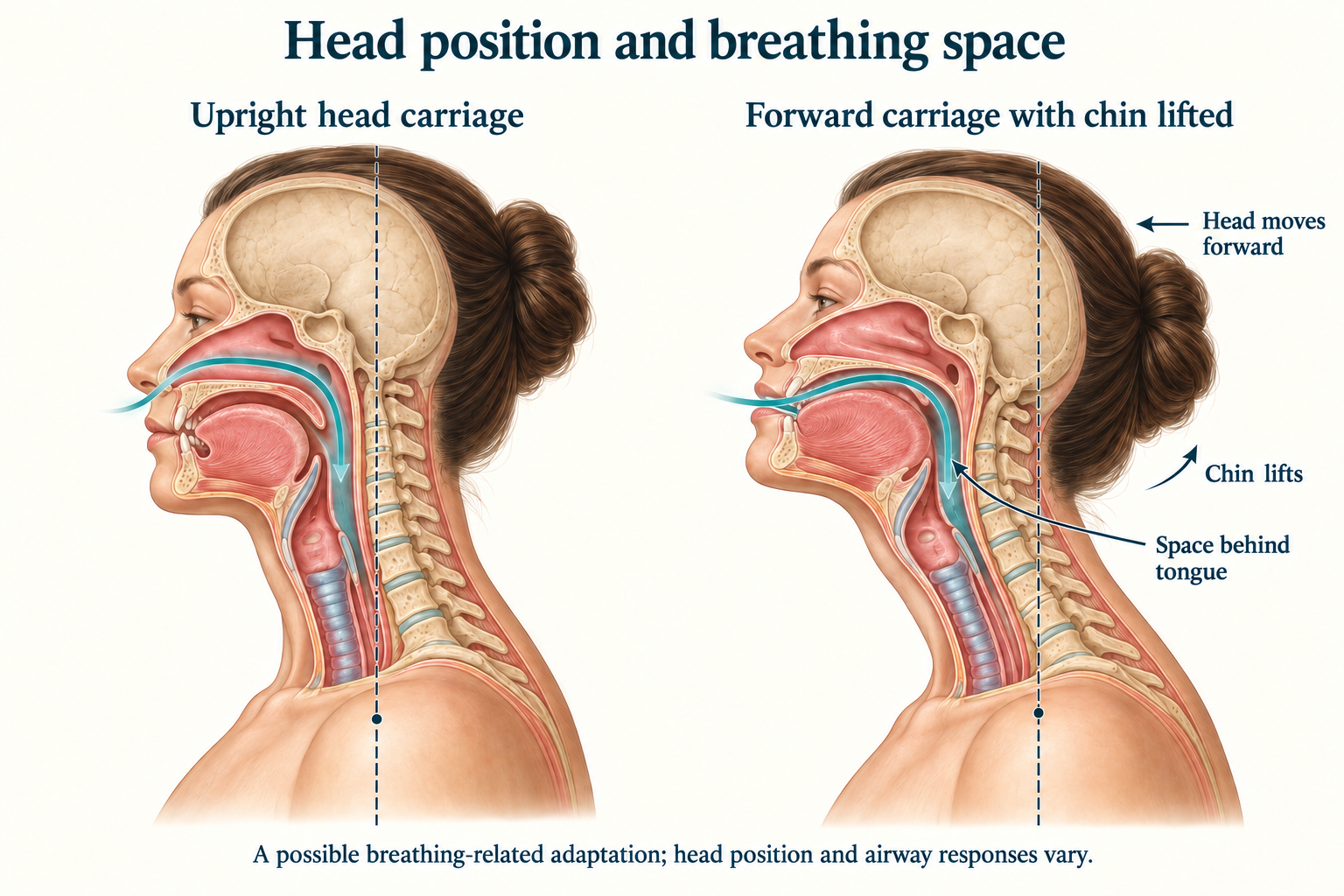
How head position can create more room for breathing
The pharynx—the throat passage behind the nose and mouth—is surrounded by movable structures, including the tongue, soft palate and connected muscles. Its available space changes with the position of your head, neck and jaw.
Moving the neck forward while lifting the chin changes these relationships. Research shows that head extension can increase space in parts of the throat, particularly behind the tongue and lower down. The effect differs between regions and individuals; it does not open every narrowed area equally.
When nasal breathing is difficult, this can become a position you repeatedly adopt to make breathing feel easier. You may barely notice the adjustment until airflow improves and holding your head upright becomes more comfortable.
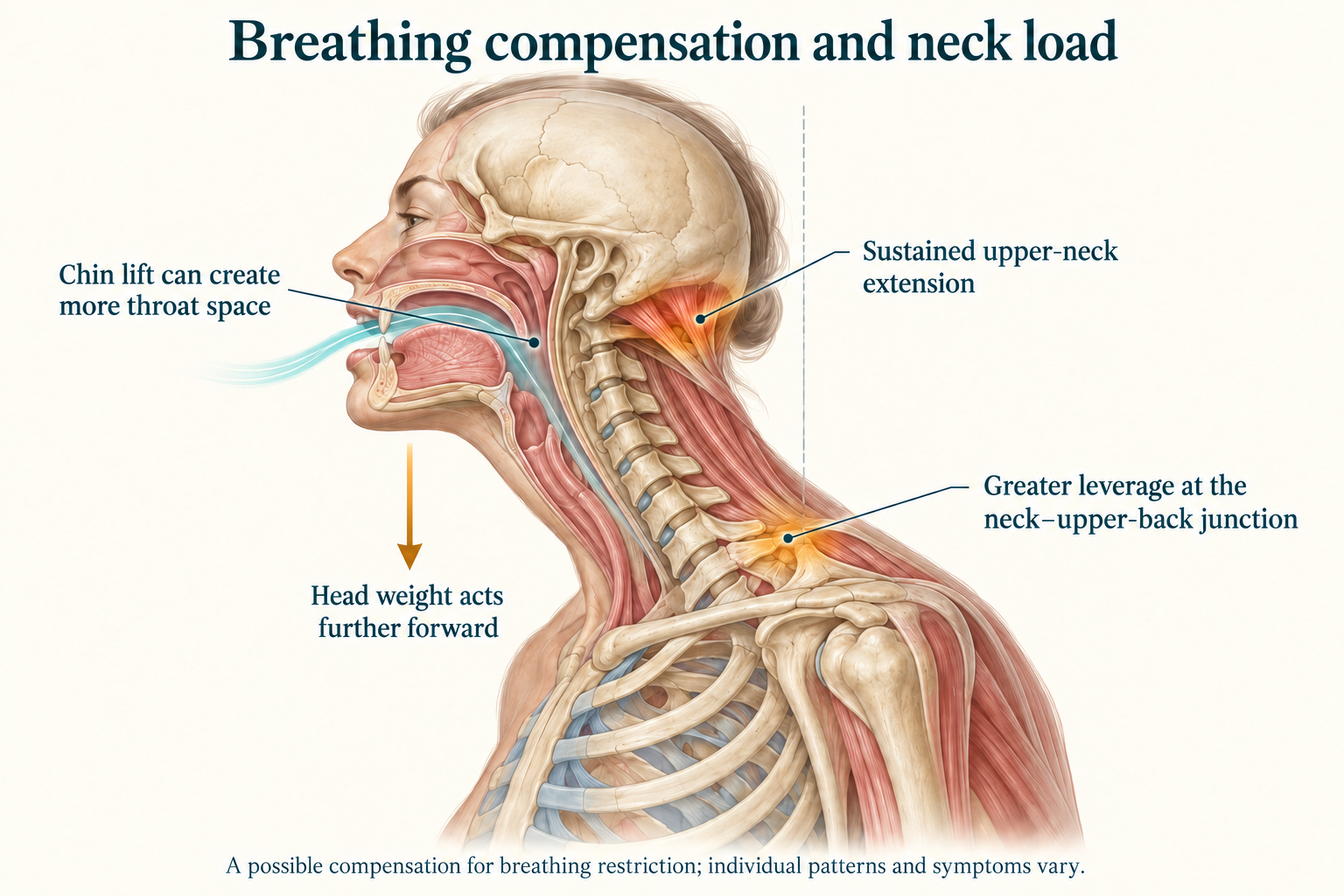
How forward head carriage can keep loading the neck
When the head sits further forward and the chin is lifted, the upper neck remains extended while the lower neck adopts a different alignment. Holding this position places sustained demands on the muscles and joints supporting the head and can contribute to recurring tension at the base of the skull.
The load also reaches the cervicothoracic junction—the transition between the neck and upper back. The head has not become heavier, but its weight acts further in front of this supporting region. That longer leverage increases the turning force that muscles and other supporting tissues must balance.
If this position is repeatedly used to make breathing easier, the mechanical demand may continue even after massage or an adjustment eases the tension. At Cranial Solutions, we assess whether nasal restriction is maintaining that compensation, whether spinal and shoulder mechanics are the main driver, or whether both need attention.
Could restricted nasal breathing be the missing piece?
If you regularly visit a chiropractor or massage therapist for upper-neck tension, but relief is short-lived, it is worth asking what keeps bringing the tension back.
Restricted nasal airflow may be the missing piece. When your head position helps compensate for difficult breathing, treating the neck alone may leave that contributing factor unresolved.
At Cranial Solutions, we assess both nasal function and spinal mechanics. Where breathing restriction is driving the pattern, establishing easier nasal airflow with NasalRx may help resolve recurring upper-neck tension rather than repeatedly easing it for a short time.
What we assess—and what changes after treatment
We look at how you breathe and move together. Your assessment includes nasal airflow on each side, the connected facial structures, jaw movement, resting head carriage, shoulder position, and movement through the neck and thoracic spine.
We also ask what happens in everyday life. Does lifting your chin make breathing easier? Does tension return after massage or an adjustment? Is nasal breathing more difficult when lying down?
Comparing before and after care
Where NasalRx is suitable, we compare breathing ease, resting head position, neck movement and palpatory findings before and after treatment.
A rapid change in head carriage as nasal breathing becomes easier can help us understand how much compensation is involved. We consider that response alongside the rest of your assessment, then review whether the improvement continues between visits.
Our aim is to address the main contributor and the secondary changes together—working towards lasting breathing comfort, easier head carriage and resolution of recurring tension where possible.
Frequently asked questions
Can a blocked nose contribute to forward head posture?
Yes. Restricted nasal breathing can contribute to a compensatory head position, including moving the neck forward and lifting the chin to create more space in parts of the throat. At Cranial Solutions, we assess whether breathing restriction, spinal mechanics or a combination is contributing to your head carriage.
Why does my upper-neck tension keep returning after treatment?
Massage or an adjustment may ease tension while a contributing factor remains. If your head position is helping compensate for restricted breathing, that demand may continue after the neck feels better. We assess nasal airflow alongside the neck, shoulders and spine to understand what keeps the pattern returning.
Can I have an assessment if I already see a chiropractor or massage therapist?
Yes. If upper-neck tension keeps returning despite regular care, we can assess whether restricted nasal airflow is contributing to the pattern. We consider what previous treatment has achieved, examine spinal and shoulder mechanics, and explore whether improving nasal breathing could help you achieve a more lasting change.
Can NasalRx improve forward head carriage?
In our clinical experience, easier nasal airflow after NasalRx often accompanies a noticeable—and sometimes rapid—improvement in head carriage. We compare your posture, breathing and movement before and after care, then follow whether those changes last. Spinal and shoulder contributors are addressed where relevant.
Could breathing be involved even if my nose does not feel badly blocked?
Yes. You may have become accustomed to breathing that takes more effort than you realise. Patients sometimes only appreciate the restriction once nasal airflow becomes substantially easier. Your assessment considers breathing comfort and compensatory patterns, alongside how blocked your nose feels.
Find out what keeps bringing your neck tension back
If upper-neck tension repeatedly returns, or holding your head upright feels effortful, an assessment at Cranial Solutions can help identify what is maintaining the pattern.
We bring nasal function, facial structure and spinal mechanics into one assessment, with the aim of resolving the main contributor and helping you achieve lasting comfort.
Explore NasalRx care or contact Cranial Solutions to arrange an assessment.
Related reading
- Blocked Nose & Sinus Pressure
- Nasal Breathing vs Mouth Breathing
- Blocked Nose at Night
- Neck Pain, Headache & Migraine
- NasalRx Safety & What to Expect
Research and further reading
- Sitting posture, cervicothoracic load and extensor activity
- Sitting posture and loads at the cervicothoracic joint
- Neck muscle–tendon lengths in neutral and forward head positions
- Vig et al., 1980
- Tourne and Schweiger, 1996
- Solow et al., 1996
- Pirila-Parkkinen et al., 2012
- Wenzel et al., 1983
- Tecco et al., 2005
- Adenotonsillectomy posture study, 2018
- Multidisciplinary adenoidectomy study, 2026
These studies explore breathing and posture; they do not establish NasalRx-specific postural outcomes. The rapid changes described here reflect Cranial Solutions clinical observations.