
Sinus Pressure & Sinus Headaches: Causes, Drainage & Treatment Options
When your face feels heavy, congested or under pressure
Persistent pressure across your cheeks or forehead can leave your whole face feeling uncomfortable. You may notice aching around your eyes, discomfort in your upper teeth, or a headache that keeps returning. Nasal blockage and sinus discharge draining into the throat can add to the frustration.
Your sinuses are air-filled spaces within the facial and cranial bones. Their lining produces protective secretions, which normally clear through small openings into the nasal passages. Inflammation, swelling and the surrounding anatomy can affect how well these spaces ventilate and drain.
At Cranial Solutions, we look closely at nasal breathing, facial movement and the relationships between the bones surrounding these passages. NasalRx is central to our approach. In clinical practice, we regularly see patients experience easier nasal breathing, reduced facial pressure and improved discharge clearance following treatment.
Our aim is lasting improvement: a face that feels clearer and more comfortable, with easier breathing and less disruption from recurring symptoms. Assessment also helps distinguish sinus-related symptoms from migraine or dental causes, which can produce discomfort in similar areas.
How your sinuses drain—and why pressure can develop
Your sinus cavities sit within the bones of your cheeks, forehead, between your eyes and deeper behind your nose. Each connects to the nasal cavity through a small opening that allows ventilation and the clearance of sinus secretions.
Tiny moving hairs called cilia sweep these secretions towards the openings. This is an active cleaning system: your sinuses do not simply empty with gravity. In the cheek sinuses, the natural drainage opening sits high on the inner wall, so the cilia carry secretions upwards towards it.
Several sinus drainage pathways converge around the middle meatus, a passage beneath the middle turbinate inside your nose. Other sinuses open higher up or further back. These small spaces connect sinus health with the condition of the nasal lining and the surrounding facial anatomy.
When inflammation swells the lining or a drainage pathway becomes narrowed, ventilation and clearance can be disrupted. Secretions may accumulate, and the irritated lining can contribute to facial aching, fullness and pressure.
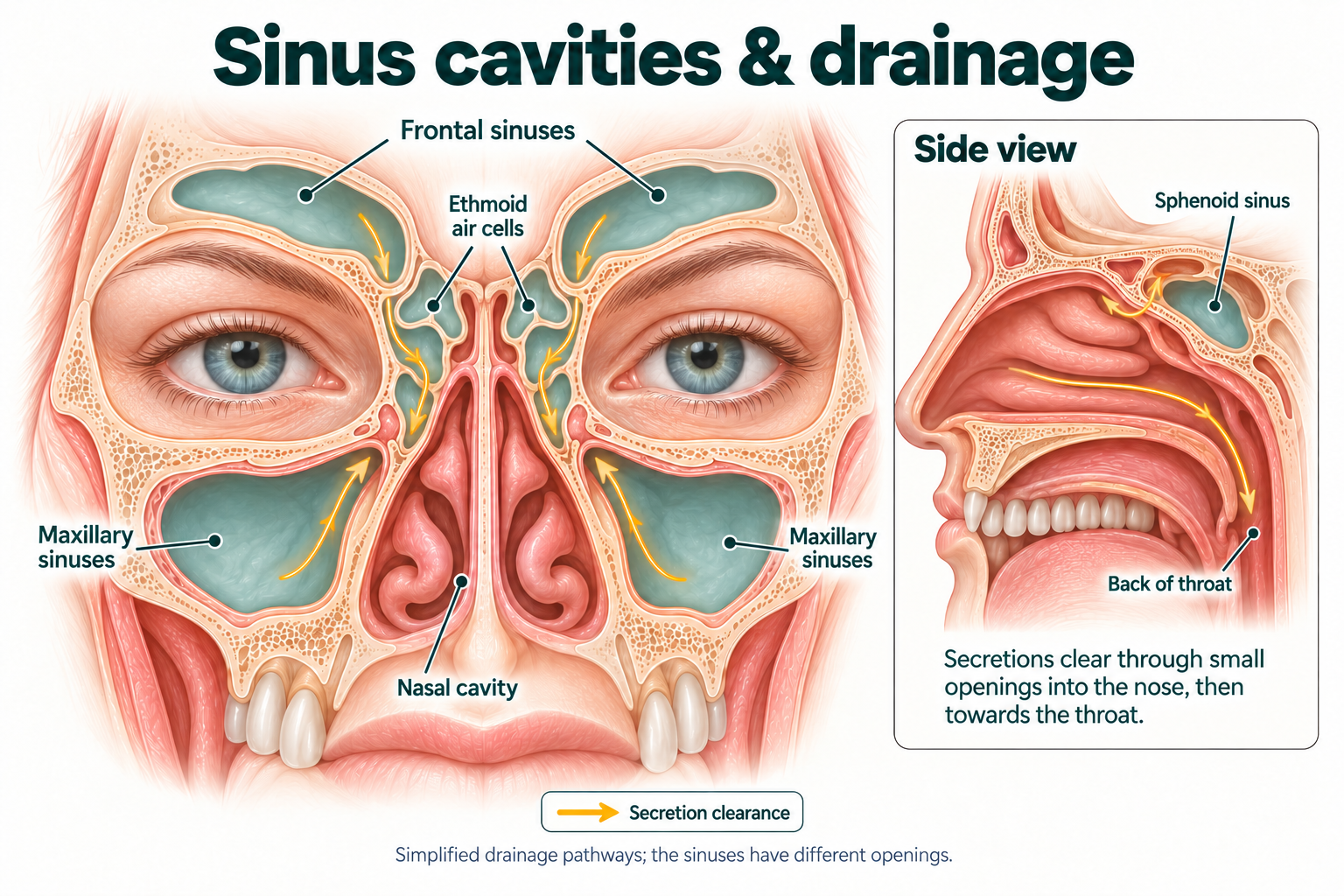
Sinus pressure in the cheeks, forehead and upper teeth
The location of your discomfort can offer useful clues. You might feel a heavy ache beneath your eyes, pressure across your forehead, or discomfort that seems to spread into your upper teeth.
- Cheeks and beneath the eyes: the maxillary sinuses sit within the upper jaw bones. Inflammation here can cause aching or fullness in the cheeks and sometimes discomfort in the upper back teeth.
- Forehead and above the eyes: the frontal sinuses sit within the forehead bone. Inflammation in this region can be associated with pressure or tenderness above the eyes.
- Between or behind the eyes: sinus-related discomfort can occur around this region, although the location alone does not identify which sinus—or whether a sinus—is responsible. For more on eye discomfort and its relationship to migraine, read our headache behind the eyes guide.
The cheek sinuses sit close to the roots of the upper back teeth, and their sensory nerve supply is closely related. This helps explain why sinus inflammation can sometimes feel like toothache. The relationship also works in the other direction: a dental infection can affect a nearby cheek sinus.
Pressure on one side deserves attention, particularly when it persists. A painful tooth, jaw tension and migraine can also cause facial discomfort, so we consider the whole pattern rather than assuming that every ache means trapped sinus discharge.
At Cranial Solutions, we compare the pressure you describe with facial tenderness, cranial and facial movement, nasal breathing and discharge symptoms. We also assess jaw symmetry and movement patterns, including how the jaw opens and closes and whether the temporomandibular joints (TMJs) are uncomfortable or restricted. Where jaw dysfunction contributes to your symptoms, treatment also aims to improve jaw movement and comfort.
Sinus headache without congestion: could it be migraine?
You can feel pressure across your forehead, cheeks or behind your eyes even when your nose feels clear. Although this is often described as a “sinus headache”, the sensation does not necessarily mean a sinus is blocked or infected.
Migraine can cause facial pressure and pain around the eyes, sometimes alongside a blocked or runny nose. If episodes also bring nausea, sensitivity to light or sound, or pain that worsens with ordinary activity, migraine deserves consideration.
This does not make your facial symptoms any less real. It helps us understand what needs attention. At Cranial Solutions, we consider the headache pattern alongside nasal symptoms, cranial and facial movement, jaw function and tenderness. Sinus symptoms, migraine and jaw problems can also occur together.
If recurring headaches or migraine are the main concern, our migraine and headache guide explains our assessment and treatment approach in more detail.
How to relieve sinus pressure and improve drainage
Lasting improvement starts with understanding what is contributing to your symptoms. The condition of the sinus lining, the drainage pathways and the surrounding facial structures all deserve consideration.
The NasalRx approach at Cranial Solutions
At Cranial Solutions, NasalRx offers a non-surgical approach focused on nasal function and the cranial and facial framework surrounding the passages. Our assessment considers the upper jaw, palate, septal region and other connected facial structures, alongside the nasal tissues and your symptom history.
In clinical practice, we regularly observe easier nasal breathing, reduced facial pressure and changes in sinus discharge following NasalRx. Patients may notice discharge clearing towards the back of the throat, together with a lighter, more comfortable feeling across the face.
Depending on the assessment, NasalRx may be considered on its own or alongside treatment for allergy or inflammation, with the aim of resolving persistent symptoms or substantially reducing their impact.
Other approaches that may support the sinus lining
Saline rinses can help clear nasal secretions, while prescribed nasal steroid sprays can reduce inflammation. Allergy treatment may also help when allergies are contributing. Antibiotics are appropriate for selected bacterial infections; they are not a treatment for every episode of sinus pressure.
If you have tried these approaches, we review what they have achieved and what remains troublesome.
Persistent sinus pressure and chronic sinusitis
When facial pressure, nasal blockage or troublesome discharge becomes part of everyday life, it is worth looking beyond short-term relief. Understanding why symptoms persist helps us choose a more focused approach.
Chronic sinusitis, also called chronic rhinosinusitis, involves inflammation of the nose and sinuses with symptoms lasting at least 12 weeks. These may include nasal blockage, discharge, a reduced sense of smell and facial pressure. Diagnosis requires evidence of inflammation on a nasal examination, endoscopy or CT scan, alongside the symptom history.
Persistent pressure alone does not establish chronic sinusitis. Nor does chronic sinusitis necessarily mean a continuous bacterial infection. Inflammation, allergies, nasal polyps and anatomical narrowing can contribute in different combinations.
If you have already had investigations, nasal sprays, antibiotics or sinus surgery, we review those findings and what treatment has changed. This gives us a clearer starting point for assessing whether NasalRx is suitable for the symptoms that remain, alongside any care needed for diagnosed sinus disease.
Do you need a CT scan before considering NasalRx?
A CT scan is not an automatic requirement for everyone considering NasalRx. We first review your symptoms, examination findings and any previous investigations. Where assessment indicates that NasalRx is suitable and no further investigation is needed first, we can discuss a course of treatment and review your response.
If the treatment course brings only moderate improvement or symptoms remain troublesome, we review what has changed and whether further investigation would help explain the remaining symptoms. Nasal endoscopy or a targeted sinus CT scan may then be useful. Findings that raise concern about another condition warrant investigation before treatment.
Sinus CT uses radiation, with the dose depending on the scanner and protocol. Lower-dose options are available at some centres, so patients can ask about the expected dose and whether the scan would change their care.
The NasalRx protocol: treatment and reviewing your progress
Where assessment indicates that NasalRx is suitable, we generally recommend a series of six treatments. This gives us the opportunity to work progressively and review how your nasal and facial function responds throughout the course.
Before treatment, we discuss your symptoms, previous care, relevant medical history and what you hope to change. We explain the procedure, its possible risks and what to expect, so you can make an informed decision.
Progress is assessed through both your experience and our examination. We review:
- Facial pressure and pain: whether the cheeks, forehead and areas around the eyes feel clearer and more comfortable.
- Nasal breathing: how easily air moves through each side of the nose.
- Discharge symptoms: changes in drainage towards the throat, congestion and the need to clear secretions.
- Facial and jaw function: changes in palpatory tenderness, cranial and facial movement, jaw symmetry and movement patterns.
- Everyday impact: whether symptoms recur less often and interfere less with sleep, work and daily activities.
Your reported changes and our palpatory findings help us track clinical progress; they do not directly measure the size of sinus openings or the amount of drainage from an individual cavity.
Our aim is to resolve persistent sinus discomfort wherever possible and, where symptoms remain, achieve a substantial improvement in comfort and function. We review progress throughout the protocol, rather than waiting until the final treatment to assess the response.
Read more about NasalRx treatment and safety and what to expect.
Frequently asked questions
How long does a sinus headache last?
There is no single duration because “sinus headache” can describe several different problems. Symptoms associated with a cold may settle as the illness clears, while recurring facial pressure needs assessment of the underlying cause. At Cranial Solutions, we ask how often symptoms occur, how long each episode lasts and whether you feel clear between episodes.
Why do I have maxillary sinus pain on one side?
One-sided cheek discomfort can be associated with local sinus inflammation, a dental problem or another source of facial pain. The location is a useful clue, but does not establish the cause. We consider nasal symptoms alongside the teeth, jaw and facial findings, with dental assessment where a tooth-related cause is suspected.
Can NasalRx help sinus symptoms if my nose already feels clear?
A comfortable breathing passage does not tell us everything about sinus function. In our clinical experience, patients can report reduced facial pressure and troublesome discharge even when nasal blockage was not their main concern. Assessment helps determine whether NasalRx is suitable for your particular pattern of symptoms.
Does yellow or green sinus discharge mean an infection is clearing?
The colour alone cannot tell us that. Yellow or green discharge can occur with inflammation and different types of infection; it does not confirm bacteria, fungus or that an infection has cleared. After treatment, we review discharge changes alongside facial comfort, breathing and your overall symptoms.
Can I consider NasalRx before sinus surgery?
Yes. Being advised to consider elective sinus surgery does not automatically rule out exploring NasalRx. You can arrange an assessment at Cranial Solutions to discuss this approach, including the reason surgery was recommended and what previous treatments or investigations have shown.
Where NasalRx is suitable, we recommend considering a six-treatment course and reviewing your response before deciding on elective surgery.
Our aim is to achieve lasting improvements in sinus comfort and nasal function that may make elective surgery unnecessary. Your response helps inform whether further treatment is still warranted.
Related guides
- Blocked Nose & Sinus Pressure
- Post-Nasal Drip
- Deviated Septum & Nasal Obstruction
- Swollen Turbinates & Blocked Nose
- Nasal Sprays & Rebound Congestion
References and further reading
- NIH MedlinePlus: Sinusitis
- Anatomy, Head and Neck, Nasal Cavity
- ENT Health: Sinus Headaches
- ENT Health: Sinus Disease and Disorders
- Schreiber et al. (2004): Migraine in patients reporting sinus headache
- Adult Sinusitis Guideline Update (2025)
- River Radiology: clinical availability of lower-dose CT options
Descriptions of changes following NasalRx reflect Cranial Solutions’ clinical observations. These sources support anatomy and symptom distinctions, rather than demonstrating NasalRx treatment outcomes.